Selasa, 20 Maret 2012

The Cat Movie Review (Korean Movie)

Diposting oleh Unknown di 06.28 0 komentar


  • Movie: The Cat
  • Revised romanization: Goyangyi: Jookeumeul Boneun Doo Gaeui Noon
  • Hangul: 고양이 : 죽음을 보는 두 개의 눈
  • Director: Byun Seung-Wook
  • Writer:
  • Producer: Lee Joon-Dong
  • Cinematographer:
  • Release Date: July 7, 2011
  • Runtime: 106 min.
  • Distributor: Next Entertainment World
  • Language: Korean
  • Country: South Korea


Plot :

Byeon Seung-wook's "The Cat" has been misjudged and misunderstood. Before writing this I came across a number of reviews citing numerous issues they had with the film. These criticisms largely stemmed from examining the film as strictly a 'horror' film and how the conventions of the genre weren't well executed within it. In addition, "The Cat" was seen to contain poor tonal and thematic motifs, impotently embossing its narrative with soft-core techniques and themes that resulted in nothing more than an average viewing experience. This displeased me because my initial reaction to the film was very positive. After some thought and reflection on the film, I began to formulate some of reasons I found this film to be not only entertaining but thought provoking as well.
Now, before I dive into some of the reasons I found this film to be well above average, lets look at the basic story here. Park Min-yeong makes her film debut as So-hee, a good-natured cat-lover who is tormented by a traumatic childhood experience. She suffers from chronic claustrophobia as she lives in constant fear that, if left in an enclosed space, some imminent danger will engulf her. So-hee works with an eccentric gentleman as a pet groomer. When her latest client is mysteriously murdered, she takes on the responsibility of caring for her cat "Silky". However the cat seems to come with some unwanted baggage in the form of a disturbing little girl (Hee-jin played by Kim Ye-ron) who haunts her from there on out. 
The mystery, at least initially, is discovering the link between the cat, the young girl, our protagonist, and the deaths surrounding them. But once that link is chained the film undergoes a subtitle shift as the mystery gives way to film's primary focus, that of visual expressing our protagonist's psychological journey of healing. "The Cat" may make use of some horror conventions but if that mind-set is continued throughout, the film will no doubt appear to fall short in many areas. The "mystery" of events will then result in the climax of the film being misinterpreted and seem almost obvious and unbecoming of true horror.

South Korean films have always appeared to me to have issue with genre, and "The Cat" is no exception. I feel that a lot of the negative feedback the film has received has been unjustly dished out as a result. The viewer may be primed with a generic expectation that some may not be willing to surrender when the film modifies its course. A horror film it is not, at least not when considered in the traditional sense. If I had to force a category onto "The Cat", I think it would better be appreciated as a psychological fear film. I don't mean to debate semantics here but the criticisms the film has received seem so off the mark that I think such a distinction is necessary.
Our protagonist suffers with both internal (her claustrophobia) and external (the child ghost) conflict and the degree to which they are connected is vital in understanding the film in its entirety. As the film progresses, the distance between So-hee psychological condition and the real-world events that follow her continues to narrow. There is a huge gap between her being attack by a ghostly figure under her bed to her embracing the deceased girl within a confined space at the end. This is where the film works its magic, through the thematic pairing of So-hee and the little girl, the filmmakers have work into the mechanics of the piece a link between them that is mutual inclusive as their conflicts become simultaneously resolved.
So-hee suffered a trauma when she was a little girl and it is now a little girl who haunts her. Her resolve to discover the truth behind Hee-jin and her hauntings is one that serves a dual purpose. The first is the most noticeable, to resolve the story behind the ghost that can't move on. The second is that all though it is Hee-jin who can't move on, it is So-hee who is struggling to move forward. Their fates are entwined and the filmmakers have laid the groundwork for that synergy, weaving it into both the narrative and the overall tone of the film.


Consider that the victims of the Hee-jin are never actually "haunted" by their ghostly killer, but our heroine is. So-hee's hauntings are her fears incarnate, something that needs to be confronted in order to transcend them. Unlike the victims, she did not threaten the cats and as such her life was not at risk. The viewer knows this but we also need to probe as to why this is. Here we can see a psychological agent emerge, as So-hee's fear is visual represented through the hauntings (the unresolved conflict that lingers). Hee-jin is what she fears (representing both internal and external conflicts), the danger in the dark, the threat that dwells in enclosed spaces. Parallels like this are there to be seen and the connection between them is key to understanding the film's progression.
Almost every review I read acknowledged that film was competently made and visually quite attractive. But in the same breath lay criticism against it as a horror film. "The Cat" contains some very elegant composition and the cinematography is not only eye-catching, it's appropriate. Films that contain overt psychological elements have this theme manifest itself not only through content but through form as well. The mechanics of the film are definitely on the same page in "The Cat" as the message and visuals exists as one. Many a scene is introduced with a shallow depth of field that refocuses as character enter. As if there is a constant effort to illude to a presence existing in the space prior to action. A stillness, or pretext, that primes the scene with a strong sense of unease. It is almost as if we, the viewer, are briefly possessing that which So-hee fears -- the danger in the dark, the object of her despair lurking in the corner. Similarly, the frequent use of extreme close-ups act as reminders to the details that exists in the world and the meaning they can hold, constantly screaming "look closer".
Clues to Hee-jin's fate can be seen in her eyes as the screen is dominated early on by their cat-like coldness. Walls and door handles are put in focus as objects that define boundaries, in which So-hee's fear resides. The film's visual aesthetic is a claustrophobic one and it serves the narrative well within the film's thematic considerations. All the murders take place within confined spaces, reinforcing the fear we know So-hee has to overcome. Even the film's palate was inline with this idea as muted tones of yellow, blue, and grey washed over each scene and helped to paint an uncomfortable psychodynamic. Yellow, in particular, was dominant, eliciting feelings of fear, danger, unease, friendship, hope, and covetousness. All applicable to "The Cat" and the struggles and trials our characters go through. This is where the film draws you in, not though its shock and horror techniques, but through subtitle compositions and subliminal emotive techniques.


What about the cat? Yes this film is called "The Cat" but lets not get too hooked on that notion and begin referencing other, and arguably, better cat horror films. Cats in the film are the messenger, the common link shared between protagonist and the fear she must confront. They are the objects, not the subjects. Hee-jin and So-hee share unresolved issues but it is the cat(s) that brings them together to conquer them. They are not evil or sinister by themselves; they are in possession of this same-shared sense of torment felt by their human companions. If there is one trait that holds true to about cat mythology in the film it's that of being mysterious and strangely powerful. 
In the early stages of the film, when the mystery is at its highest, the cats are seen as creatures to fear. But by the end of the film their stories come to light and fear is replaced by understanding and sorrow. I feel like the cats themselves were almost a red herring in the film that distracted, and for some too much, from the films true intentions. They served their purpose perfectly and, even though they could be simplified to being just a story hinge, their impact was justified. Questions beyond their intended function are pointless and shortsighted, narrowing the reading of the film to one that is limited to overreaching preconceptions and ill-serving contextualization.  
"The Cat" deserves some credit, and from what I have read thus far it has not gotten that. The film's message and ideas are woven into its mechanics with such cinematic sensibility and consideration that it's hard not walk away with some appreciation. Dismissing the film as a failed horror is not only unfair, its completely unjustified. In writing this I have hope to share some of the film's less obvious layers that I believe make it a great film worthy of any recommendation. 

  • Movie Picture Gallery


adapted from : www.google.com


Minggu, 18 Maret 2012

Plasmodium vivax (English version)

Diposting oleh Unknown di 19.40 1 komentar


Kingdom:Chromalveolata
Superphylum:Alveolata
Phylum:Apicomplexa
Class:Aconoidasida
Order:Haemosporida
Family:Plasmodiidae
Genus:Plasmodium
Species:P. vivax


Plasmodium vivax is a protozoal parasite and a human pathogen. The most frequent and widely distributed cause of recurring (Benign tertian) malariaP. vivax is one of the four species of malarial parasite that commonly infect humans. It is less virulent than Plasmodium falciparum, which is the deadliest of the four, and is seldom fatal. P. vivax is carried by the female Anopheles mosquito, since it is the only sex of the species that bites.

Epidemiology

P. vivax is found mainly in the United States, Latin America, and in some parts of Africa. P. vivax can cause death due to splenomegaly (a pathologically enlarged spleen), but more often it causes debilitating – but non-fatal – symptoms.[1][2] Overall it accounts for 65% of malaria cases in Asia and South America.

Treatment

Chloroquine remains the treatment of choice for vivax malaria, except in Indonesia's Irian Jaya (Western New Guinea) region and the geographically contiguous Papua New Guinea, where chloroquine resistance is common (up to 20% resistance). Chloroquine resistance is an increasing problem in other parts of the world, such as Korea,India.
When chloroquine resistance is common or when chloroquine is contraindicated, then artesunate is the drug of choice, except in the U.S., where it is not approved for use. Where an artemisinin-based combination therapy has been adopted as the first-line treatment for P. falciparum malaria, it may also be used for P. vivax malaria in combination with primaquine for radical cure. An exception is artesunate plus sulfadoxine-pyrimethamine (AS+SP), which is not effective against P. vivax in many places. Mefloquine is a good alternative and in some countries is more readily available.Atovaquone-proguanil is an effective alternative in patients unable to tolerate chloroquine. Quinine may be used to treat vivax malaria but is associated with inferior outcomes.
Thirty-two to 100% of patients will relapse following successful treatment of P. vivax infection if a radical cure (eradication of liver stages) is not given. Eradication of the liver stages is achieved by giving primaquine, after checking the patients G6PD status to reduce the risk of haemolysis. However, in severe G6PD deficiency, primaquine is contraindicated and should not be used.Recently, this point has taken particular importance for the increased incidence of vivax malaria among travelers. At least a 14-day course of primaquine is required for the radical treatment of P. vivax.

Life cycle

The incubation period for the infection usually ranges from ten to seventeen days and sometimes up to a year. Persistent liver stages allow relapse up to five years after elimination of red blood cell stages and clinical cure.

Human infection

The infection of Plasmodium vivax takes place in human when an infected female anopheles mosquito sucks blood from a healthy person. During feeding, the mosquito injects sporozoites to prevent blood clotting and saliva, thousands of sporozoites are inoculated into human blood; within a half-hour the sporozoites reach the liver. There they enter hepatic cells, transform into the tropozoite form and feed on hepatic cells, and reproduce asexually. This process gives rise to thousands of merozoites (plasmodium daughter cells) in the circulatory system and the liver.

Liver stage

The P. vivax sporozoite enters a hepatocyte and begins its exoerythrocytic schizogony stage. This is characterized by multiple rounds of nuclear division without cellular segmentation. After a certain number of nuclear divisions, the parasite cell will segment and merozoites are formed.
There are situations where some of the sporozoites do not immediately start to grow and divide after entering the hepatocyte, but remain in a dormant, hypnozoite stage for weeks or months. The duration of latency is variable from one hypnozoite to another and the factors that will eventually trigger growth are not known; this explains how a single infection can be responsible for a series of waves of parasitaemia or "relapses". Different strains of P. vivax have their own characteristic relapse pattern and timing. The earlier stage is exo-erythrocytic generation.

P. vivax preferentially penetrates young red blood cells (reticulocytes). In order to achieve this, merozoites have two proteins at their apical pole (PvRBP-1 and PvRBP-2). The parasite uses the Duffy blood group antigens (Fy6) to penetrate red blood cells. This antigen does not occur in the majority of humans in West Africa [phenotype Fy (a-b-)]. As a result P. vivax occurs less frequently in West Africa.[19]
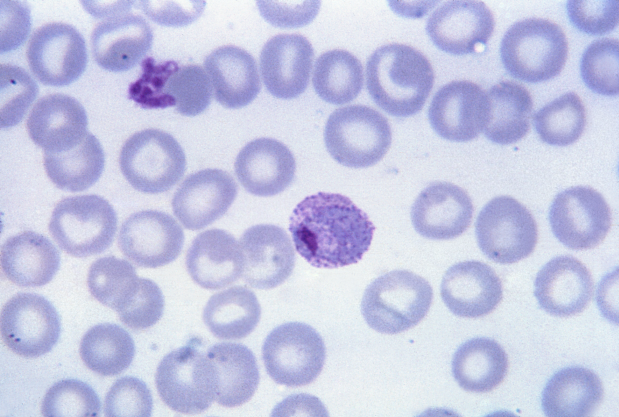
The parasitised red blood cell is up to twice as large as a normal red cell and Schüffner's dots (also known as Schüffner's stippling or Schüffner's granules) is seen on the infected cell's surface, the spotted appearance of which varies in color from light pink, to red, to red-yellow, as coloured with Romanovsky stains. The parasite within it is often wildly irregular in shape (described as "amoeboid"). Schizonts of P. vivax have up to twenty merozoites within them. It is rare to see cells with more than one parasite within them. Merozoites will only attach to immature blood cell (reticulocytes) and therefore it is unusual to see more than 3% of all circulating erythrocytes parasited


Sexual stage

The sexual stage includes following processes by which P. vivax reproduces sexually:
  1. Transfer to mosquito
  2. Gametogenesis
    • Microgametes
    • Macrogametes
  3. Fertilization
  4. Ookinite
  5. Oocyst
  6. Sporogony


What is hemoglobin ?

Diposting oleh Unknown di 19.11 0 komentar

What is hemoglobin?

Hemoglobin is the protein molecule in red blood cells that carries oxygen from the lungs to the body's tissues and returns carbon dioxide from the tissues to the lungs.
Hemoglobin is made up of four protein molecules (globulin chains) that are connected together. The normal adult hemoglobin (Hbg) molecule contains 2 alpha-globulin chains and 2 beta-globulin chains. In fetuses and infants, there are only a few beta chains and the hemoglobin molecule is made up of 2 alpha chains and 2 gamma chains. As the infant grows, the gamma chains are gradually replaced by beta chains.
Each globulin chain contains an important central structure called the heme molecule. Embedded within the heme molecule is iron that transports the oxygen and carbon dioxide in our blood. The iron contained in hemoglobin is also responsible for the red color of blood.
Hemoglobin also plays an important role in maintaining the shape of the red blood cells. Abnormal hemoglobin structure can, therefore, disrupt the shape of red blood cells and impede its function and its flow through blood vessels.

How is hemoglobin measured?

Hemoglobin is usually measured as a part of the complete blood count (CBC) from a blood sample.
Several methods exist for measuring hemoglobin, most of which are done currently by automated machines designed to perform several different tests on blood. Within the machine, the red blood cells are broken down to get the hemoglobin into a solution. The free hemoglobin is exposed to a chemical containing cyanide which binds tightly with the hemoglobin molecule to form cyanmethemoglobin. By shining a light through the solution and measuring how much light is absorbed (specifically at a wavelength of 540 nanometers), the amount of hemoglobin can be determined.


What are normal hemoglobin values?

The hemoglobin level is expressed as the amount of hemoglobin in grams (gm) per deciliter (dl) of whole blood, a deciliter being 100 milliliters.
The normal ranges for hemoglobin depend on the age and, beginning in adolescence, the gender of the person. The normal ranges are:
  • Newborns: 17-22 gm/dl
  • One (1) week of age: 15-20 gm/dl
  • One (1) month of age: 11-15gm/dl
  • Children: 11-13 gm/dl
  • Adult males: 14-18 gm/dl
  • Adult women: 12-16 gm/dl
  • Men after middle age: 12.4-14.9 gm/dl
  • Women after middle age: 11.7-13.8 gm/dl
All of these values may vary slightly between laboratories. Some laboratories do not differentiate between adult and "after middle age" hemoglobin values.

What does a low hemoglobin level mean?

A low hemoglobin is referred to as anemia. There are many reasons for anemia.
Some of the more common causes are:


What is sickle cell disease?

Sickle cell disease is a genetic condition in which the quality of hemoglobin is defective. This condition can cause abnormal hemoglobin which, in turn, can result in abnormally shaped (sickled) red blood cells. These abnormal red blood cells cannot easily pass through small blood vessels and, therefore, could deprive the body organs of adequate oxygen.
Sickle cells also have a shorter life span than normal red blood cells (10-20 days compared to 120 days). This rapid turn over may result in inadequate time to replace the red blood cells and may result in anemia.
In order for a person to have sickle cell anemia, one defective hemoglobin gene must be inherited from each parent. If only one gene is inherited from one parent, then the conditions is much milder and it is referred to as sickle cell trait.


Selasa, 13 Maret 2012

pukul 17:30

Diposting oleh Unknown di 01.00 0 komentar
Pukul 17:00
Kaki ini lihai menaiki tangga
Memasuki gedung dengan perasaan gundah
Bergegas menuju lantai dua
Berharap dia sudah berdiri disana
Jam beralih pukul 17:10
Perasaan mulai galau, sedikit kecewa
Menyadari ia belum datang
Limabelas bemit bergeser
Galau makin menggila, perasaan mulai keruh
Termenung di sudut ruangan
Masih berharap dia datang
Hingga lima menit kemudian
Aku berbalik memutuskan untuk pulang
Ia berdiri disana
Senyuman yang meruntuhkan kegalauan
Aku enggan menghampiri
Ia berjalan tenang kearahku
Sedikit malu aku menatapnya
Pukul 18:00 satu jam berlalu
Ia masih tersenyum dan akan selalu tersenyum untukku
Sampai telapak tangan ini melambai pulang
Ia tetap tersenyum
Senyuman indah yang akan selalu kurindukan

Selasa, 06 Maret 2012

" When I'm dead "

Diposting oleh Unknown di 03.11 0 komentar


When i'm dead, my dearth
Sing no sad songs for me
The green grass above me
and with showers and dewdrops wet
I shall not see the shadows
I shall not feel the rain
I shall not hear your voice again


Sabtu, 03 Maret 2012

Lirik Lagu "SUPERMAN" - SUPER JUNIOR

Diposting oleh Unknown di 22.07 0 komentar


[BAM BAM BAM BAM BAM]
[BAM BAM BAM BAM BAM]
[BAM BAM BAM BAM BAM]

EUNHYUK:
Naega sesang-eso hana bakke eopneun group-eso meotjike chumeul chugo
Unique-han eubchoribeul halttae

DONGHAE:
Sesang modeun yojeong-deuri naeke
banhae banhae naeke-ro
dallyeo-wa dallyeo-wa dallyeo-wa
I sunganeul hamkke jeulkyeo bolkka
Source: LYBIO.net

YESUNG:
Chinchihake joyonghake nareul saranghaejun saramdeureul naneun kamdongshikyeo

KYUHYUN:
kwanhi heoseburigo solchikhi mothago naeke keureon sunganirago-neun eopseotda

SUPER JUNIOR:
Urin kyumo-do chego
skill-do chego
mwodeunji chego animyeon andwae
Super Junior-neun wonrae maen jaman ppajin ireum hamyeo himsen tori SuperMan

Yeolkyeong-do chego
cheongshin-ryeokdo chego
nuga uril kamhi kkeureo-nael tenga
Super Junior-neun wonrae maen jaman ppajin ireum hamyeo himsen tori SuperMan

HEECHUL:
Cha Cha Cha da-eum nugu

SHINDONG:
Keureohke waedeul keureohke dwireul dorabona
yeoki itneunde na todeche nugureul chatneun geoya
naega Shindong

LEETEUK:
Haneul-e byeorul tada julkka
se bwa han ke du ke se ke
urineun wonrae ireobeorin byeoleul habchyeo
byeori yeol se ke
[ Lyrics from: http://www.lyricsmode.com/lyrics/s/super_junior/super_man.html ]
HEECHUL:
keureohjiman na urin wirobji anha
urin SM FAMILY-rang yojeongdeuri itji anha

RYEOWOOK:
Jujeohajima aeseo wimyeon hajima
imi chwihaebeorin keudaen superholic

SUNGMIN:
noraeul bolleo bwa ijen chumeul ddarahae
kachi shinake eoshigu cheolshigu

SUPER JUNIOR:
Urin kyumo-do chego
skill-do chego
mwodeunji chego animyeon andwae
Super Junior-neun wonrae maen jaman ppajin ireum hamyeo himsen tori SuperMan

Yeolkyeong-do chego
cheongshin-ryeokdo chego
nuga uril kamhi kkeureo-nael tenga
Super Junior-neun wonrae maen jaman ppajin ireum hamyeo himsen tori SuperMan

KYUHYUN & SUNGMIN:
Mami ulcheok halttae norael deulgo sipeul-ttae
kiboneul dallaejul mwonga piryohal-ttae uriga kyeol-e isseo
itneun chimkkeot wichyeobwa

SUPER JUNIOR:
Super Junior
We are super super superman

RYEOWOOK & YESUNG:
dweke shimshimhalttae internet keomsek halttae
Super chaman chimyeon nawa
jureureuk jureureuk jureureuk
eonje-na kyeol-e isseo
sori chilleo wichyeo-bwa

SUPER JUNIOR:
Super Junior
We are super super superman

EUNHYUK:
keoki amudo mollachwodo
me-il chesyeoneul dahae kanda

DONGHAE:
nuguda nuguda nuguda haedo
kiroki marhaejunda

SUPER JUNIOR:
hamkke keotneun kiri pirok heomnan halchirado
kyeolguk Super Junior
THE LAST MAN STANDING!


Super Junior 슈퍼주니어_SUPERMAN_MUSIC VIDEO

Diposting oleh Unknown di 22.01 0 komentar
 

CocoQuiin’s Blog Copyright © 2011 Design by Ipietoon Blogger Template | web hosting